Complete biosynthesis of the anticancer cephalotaxinone and homoerythratine
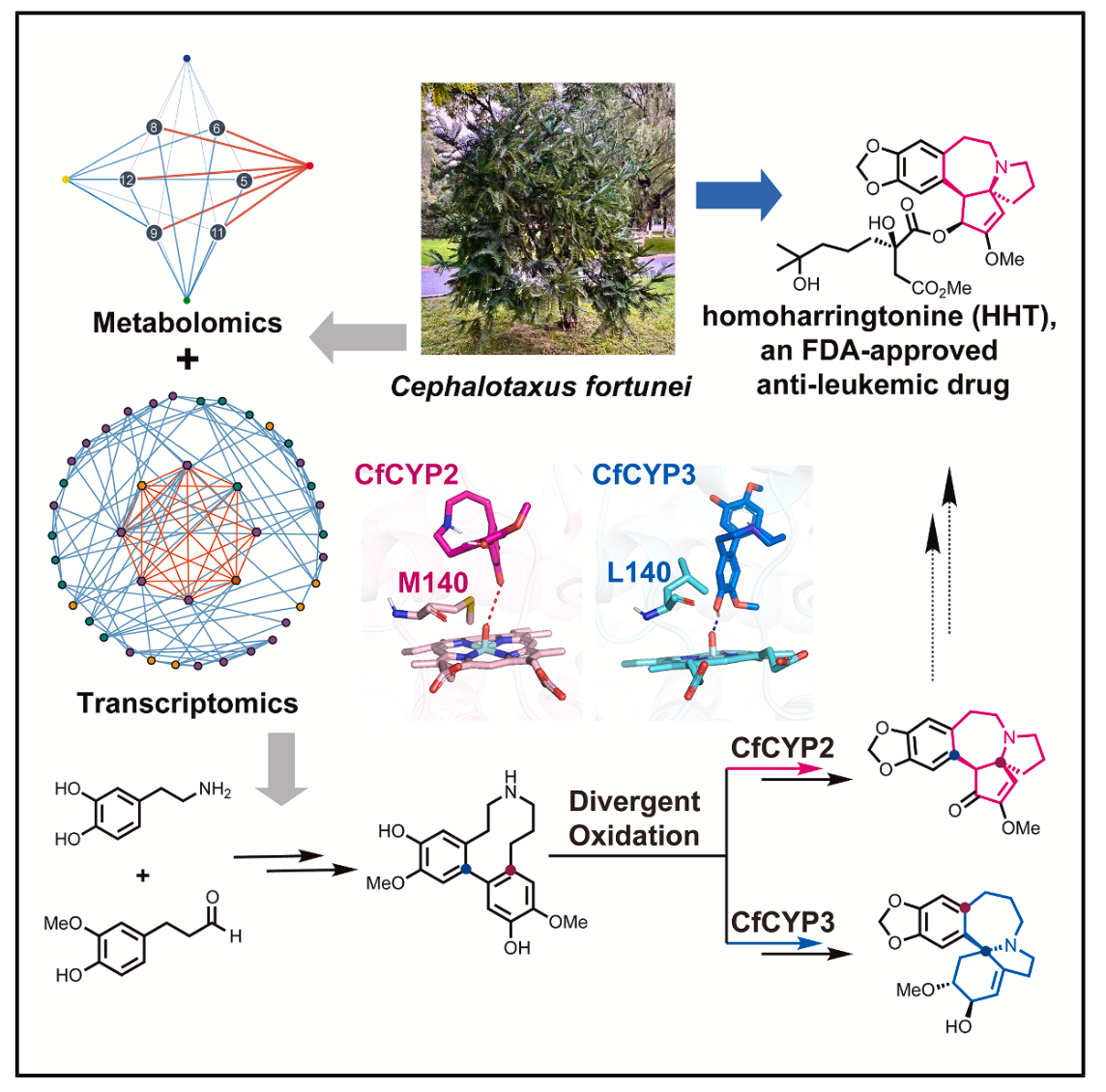
Runze Tian#, Feifan Lin#, Nianxin Guo#, Chendi Liu#, Kaiqi Chen, Yunxi Han, Ruiyun Lan, Qiang Li, Jianbin Yan*, and Xiaoguang Lei* Cell. 2026 https://doi.org/10.1016/j.cell.2026.06.007 Cephalotaxine-type and homoerythrina-type alkaloids are structurally unique and biologically important natural products isolated from endangered species that belong to the genus Cephalotaxus. Among them, homoharringtonine (HHT [1]) is a marketed drug used to treat leukemia. However, the scalable production of HHT is significantly hindered by limited natural resources. Despite intensive investigation over half a century, the complete biosynthetic pathways of these alkaloids remain unknown. Here, we applied a comprehensive multi-omics analysis and used a set of chemically synthesized standard compounds to identify the missing enzymes required for the biosynthesis of cephalotaxinone and homoerythratine. We also uncovered a rare case of divergent oxidation catalyzed by two highly homologous cytochrome P450 enzymes, CfCYP2 and CfCYP3, in the biosynthesis of two structurally distinct alkaloids. We further identified the key residues that significantly affect the divergent oxidation outcomes and ultimately reconstituted the complete biosynthetic pathways for producing these two alkaloids in N. benthamiana.
Runze Tian#, Feifan Lin#, Nianxin Guo#, Chendi Liu#, Kaiqi Chen, Yunxi Han, Ruiyun Lan, Qiang Li, Jianbin Yan*, and Xiaoguang Lei*
Cell. 2026
https://doi.org/10.1016/j.cell.2026.06.007
Cephalotaxine-type and homoerythrina-type alkaloids are structurally unique and biologically important natural products isolated from endangered species that belong to the genus Cephalotaxus. Among them, homoharringtonine (HHT [1]) is a marketed drug used to treat leukemia. However, the scalable production of HHT is significantly hindered by limited natural resources. Despite intensive investigation over half a century, the complete biosynthetic pathways of these alkaloids remain unknown. Here, we applied a comprehensive multi-omics analysis and used a set of chemically synthesized standard compounds to identify the missing enzymes required for the biosynthesis of cephalotaxinone and homoerythratine. We also uncovered a rare case of divergent oxidation catalyzed by two highly homologous cytochrome P450 enzymes, CfCYP2 and CfCYP3, in the biosynthesis of two structurally distinct alkaloids. We further identified the key residues that significantly affect the divergent oxidation outcomes and ultimately reconstituted the complete biosynthetic pathways for producing these two alkaloids in N. benthamiana.