

Stoichiometric Reduction of Dinitrogen to Hydrazine Upon Protonation of Heterobimetallic Chromium–Aluminum Hydride Complexes
Xuan-Xuan Zhao, Zhu-Bao Yin, Biguo Liang, Zhenfeng Xi, Junnian Wei*
Angew. Chem. Int. Ed. 2026, e3346028, DOI:10.1002/anie.3346028
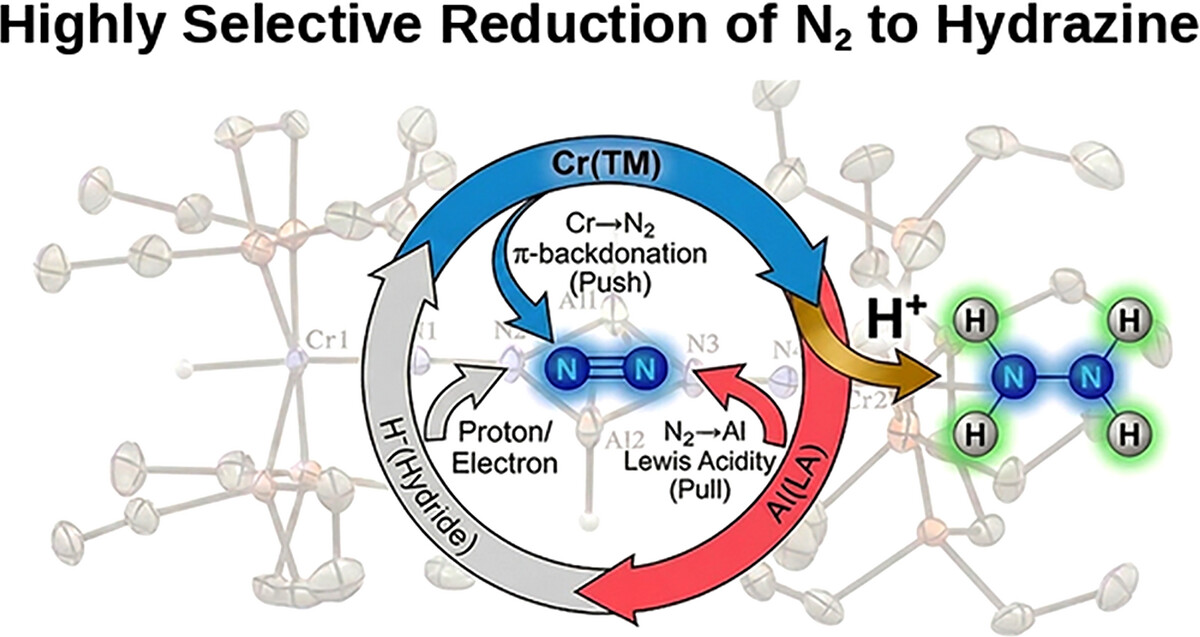
The activation of dinitrogen (N2) via heterobimetallic cooperation remains a compelling strategy for N2 functionalization. Herein, we report the synthesis and reactivity of a well-defined chromium–aluminum hydride dinitrogen complex, [(depe)2(H)Cr(μ-N2)AlH2]2 (depe = Et2PCH2CH2PEt2). Crystallographic and spectroscopic analyses reveal substantial N2 reduction driven by a “push–pull” interaction between the electron-rich Cr centers and the electrophilic Al Lewis acid core. Upon stoichiometric protonation with [Ph2NH2]OTf, the highly activated bridging N2 units undergo selective proton-coupled reduction to release hydrazine (N2H4) in up to 97% yield. Crucially, structure–reactivity investigations reveal a clear correlation between the presence of the central Al─H bonds and the selective hydrazine formation. Furthermore, the central aluminum hydrides exhibit high regioselectivity toward silyl electrophiles, enabling the precise construction of fully and partially substituted derivatives; notably, in 5–8 the Cr─N2─Al motif and terminal Cr─H units are retained. Subsequent redox investigations demonstrate that deep chemical reduction induces a core rearrangement into a unique complex, [(depe)2(H)Cr(μ-N2)]2(μ-AlH2)(μ-Li), followed by multimetallic cleavage. These transformations underscore the essential role of the Lewis acidic Al(III) center in maintaining multimetallic structural integrity and sustaining N2 activation. Overall, these findings define a heterobimetallic Cr─Al hydride framework in which the central Al─H motif governs stoichiometric hydrazine release and site-selective hydride functionalization.